
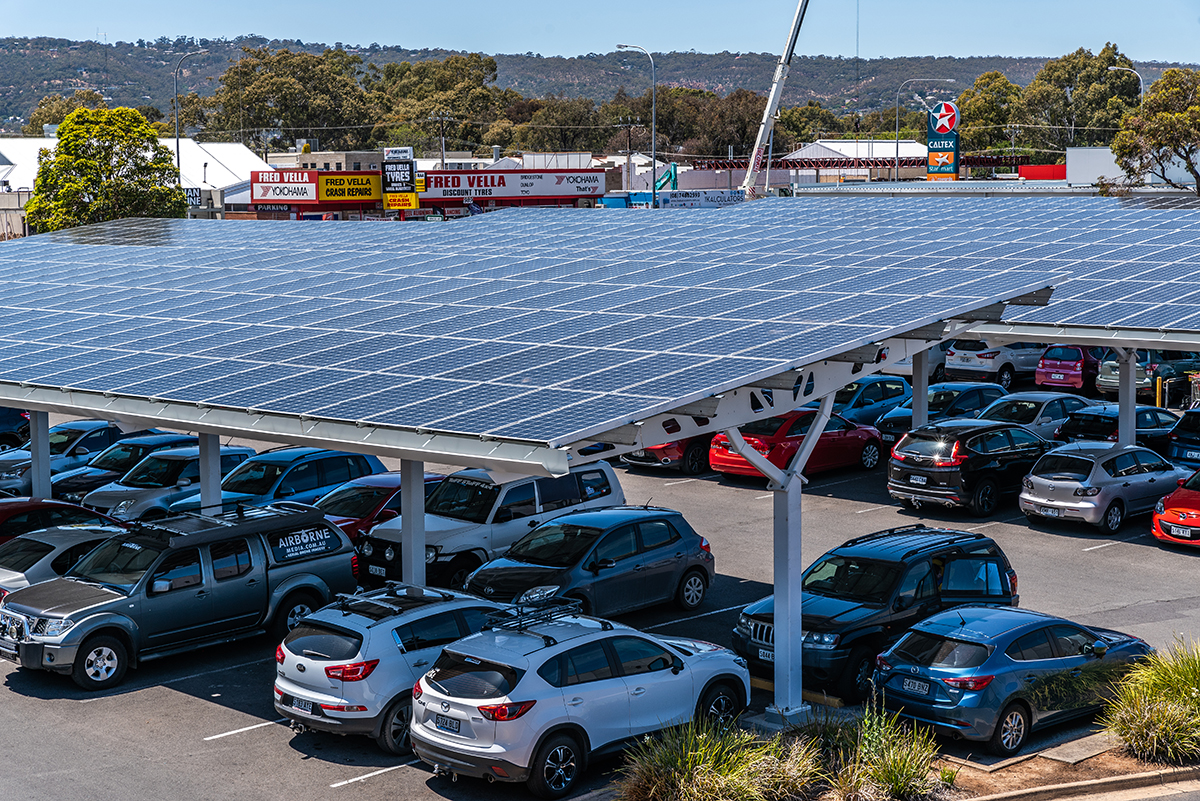
“Why aren’t there solar panels on car parks?” asked Elaine, as the consequences of climate change were becoming ever more apparent. The heatwave in Europe had prompted concerns in her science discussion group following obvious signs in the pattern of weather.
The question launched a cascade of furthers ones and a deeper exploration of what electrical energy actually is. It was common knowledge that the National Grid was going to have to change rapidly to take on the numerous new sources of electrical energy – from wind turbines out at sea and solar panels on buildings and fields. Jean’s idea was that perhaps electricity should be generated more locally, so it didn’t have to be transported over great distances. “Maybe we should connect up local sources” suggested Marian. “Yes, but how do you store it” queried Helen. “After all, lots of energy could be generated overnight but it would need to be kept somewhere until needed in the morning.
Electric current
The problem is, as Marian recalled from previous discussions, that electricity is only useful when its moving. When it’s static, electricity may give you an unexpected shock from a door handle or make your hair unruly when you comb it, but it can’t drive a washing machine, let alone a railway locomotive. Electricity is useful when charged particles are moving in a conducting material, usually a metal like copper. That’s what we call electric current, by analogy with the flow of a river. What is useful to us is the energy the particles carry with them: it’s this that turns motors and lights up bulbs. For most everyday uses, it’s the tiny particles released from atoms in a metal that do the moving.
These charged particles (called electrons) are free to move, in the case of metals and any other kind of electrical conductor.
figure 1. Model of electrons moving in a wire
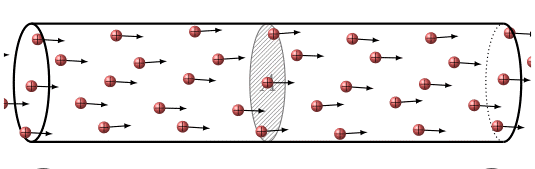
Their actual motion is fast and haphazard as they crash around between atoms, like balls in a pinball machine. But overall they drift slowly in one direction.

But in other materials, like plastics or glass for example, all the electrons are fixed inside atoms of the materials and cannot move. These so-called insulators are what we see as the coloured plastic that covers wires and the ceramic or glass objects that separate overhead power cables from the metal pylons that support them.
figure 2. Insulators on overhead cables.
Sources of energy
Batteries
Energy is imparted to the electrons in an electric current by devices designed for this purpose. These devices take energy from some other source and transfer it to the electrons
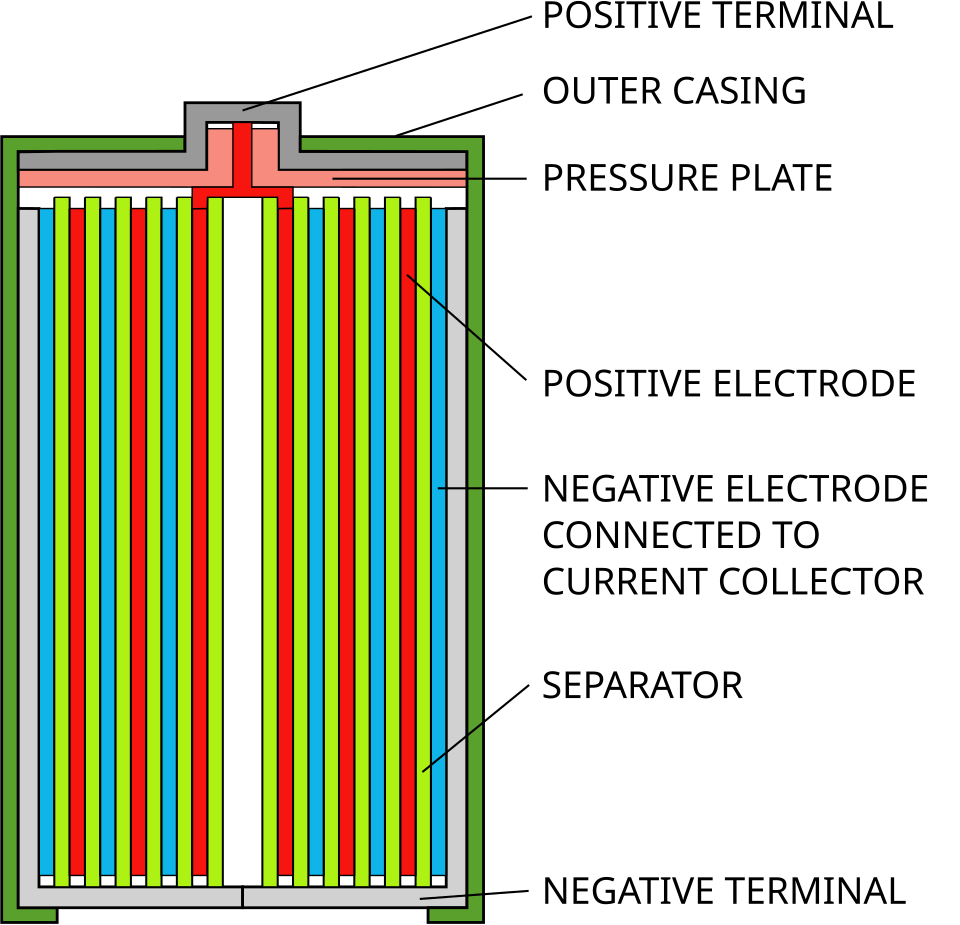
A battery is such a device, specially constructed to transfer energy from chemical reactions between the materials of which it is made to the electrons that flow through it when it is connected up in a circuit around which they can circulate.
Figure 3. Slice through a typical torch battery
Generators
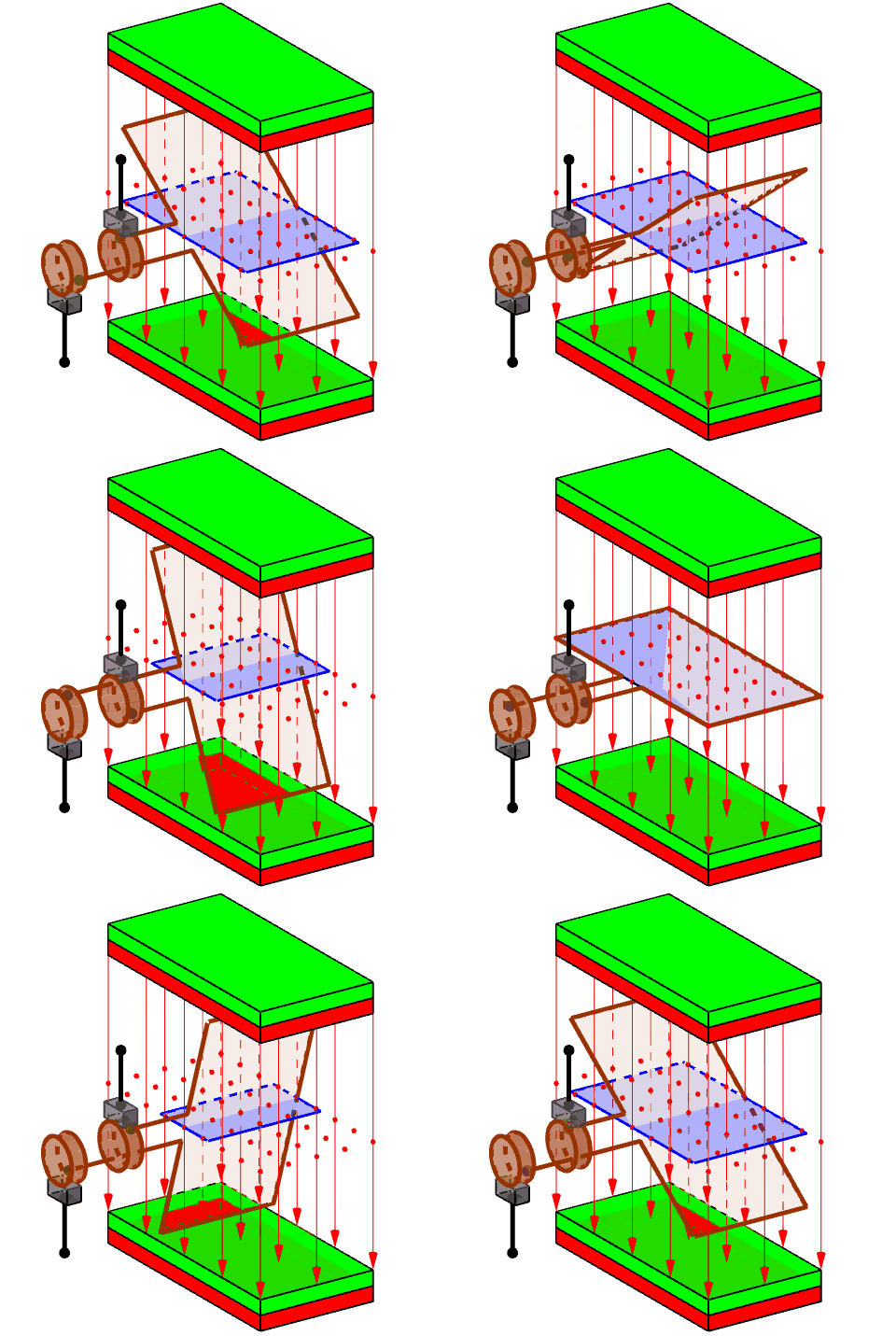
A generator is another such device. These exploit the fact that electrons in a wire are energised when they move past a magnet. Generators spin wires around and around between the poles of a big magnet. The energy is transferred from whatever is keeping the generator spinning. This may be wind turning a turbine or rushing water doing the same in a hydroelectric scheme, or, for the time being, from the steam in a boiler fired by fossil fuel.
Figure 4. Model of a rectangular loop of wire rotating through a magnetic field – a generator.
Solar panels
A third case is a solar panel. These are made up of thousands of small units called photovoltaic cells, each of which is constructed of material that creates electric current when the Sun shines on them. The material inside the cells, known as a semiconductor, contains electrons that will move along the wire if they are struck by particle of light (photons) of sufficient energy from the Sun.
What is energy?
At this point in the discussion, Marian in the group asked a fundamental question: “What exactly do we mean by energy? Is it anything physical like a fluid? Are you saying it’s not created from scratch, it simply gets transferred from one form to another – like heat or wind or chemicals into electrical energy?”.
This question taxed nineteenth century scientists trying to fathom what is happening in a steam locomotive when heat is used to drive physical motion. It was eventually proved that there was a consistent relationship between the amount of heat going into a steam engine and its capacity to move a certain distance. Experiments in the lab, measuring how much the temperature of water rose when you physically agitated it, showed that the heat energy you give to the water exactly matches the physical energy you used. The idea of a unifying principle gradually emerged: energy was interchangeable between heat from burning coal and physical motion of a locomotive, for example.
In a process like powering up a steam engine, the amount of energy remained the same throughout the process; it just changed form. The unifying idea of energy was developed as a mathematical construct, quantifying and keep track during the changes of form. The principle, known as the conservation of energy, was found to apply to all types of transformation process – leaves capturing sunlight, trampolinists bouncing up and down or petrol fumes shifting the pistons in a motor car.
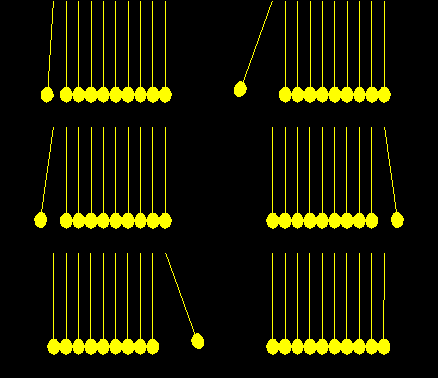
Even a pendulum swings from its highest to its lowest point by exchanging energy from gravitational type (called ‘potential’) to motion type (‘kinetic’).
Figure 5. ‘Newton’s cradle’
The idea that this mathematical entity – energy – that transfers from one form to another in all sorts of physical process but never runs out, became understood as a general principle of the universe. It’s not a fluid, it’s not anything material. It’s simply an accounting device we humans have developed to explain the way natural processes occur. It is a profoundly important and useful concept used in countless aspects of life today.
Storage
At this point in the discussion, Jean wondered aloud about storing electricity. If we can produce it cheaply overnight and use it intensively in the morning, “how much room does it need when its stored” she asked? Perhaps she was thinking about storage at home – cupboards for clothes or food, or warehouses for the products we consume.
Bearing in mind the idea of energy and its transformations, we can now see that it’s not so much ‘electricity’ that needs to be stored to heat our homes in the morning or prepare our vehicles for a trip, but energy. If electricity can’t be stored because it is only helpful when it flows, then we need to store electrical energy in a different form. We can convert it back into electrical form at the instant we need to use it.
There are several options for this and many more are being researched as the world moves away from coal, gas and oil. One way is to pump tonnes of water up into reservoirs in mountains overnight using electrical energy from slack power stations; then let it rush down in the morning to drive generators in the valley below. This way, electrical energy is converted into gravitational energy for storage, then back again into electrical form when its needed.
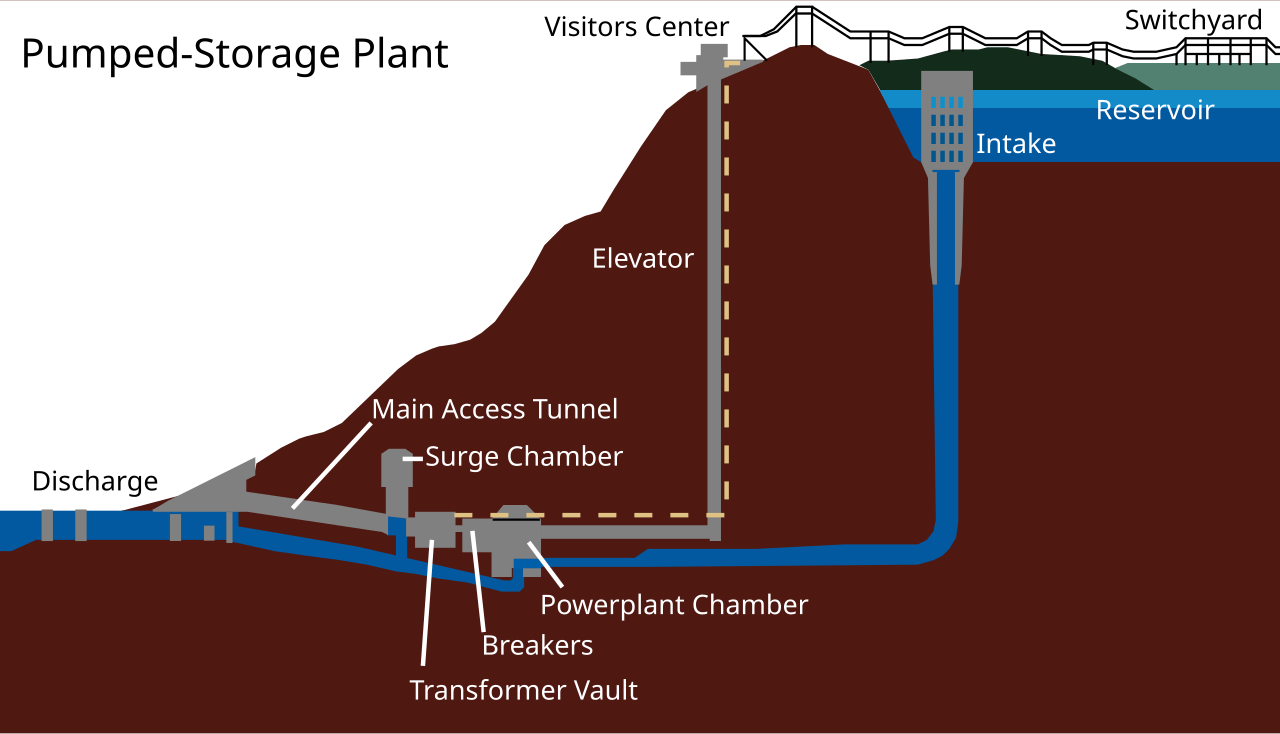
Figure 6. Model of a pumped Storage facility.
Another way is charge up large batteries, in e-vehicles for instance, ready for use for physical motion when needed. Electrical energy is transformed into chemical form when charging up, then returned to electrical form and ultimately transformed to kinetic energy of motion.
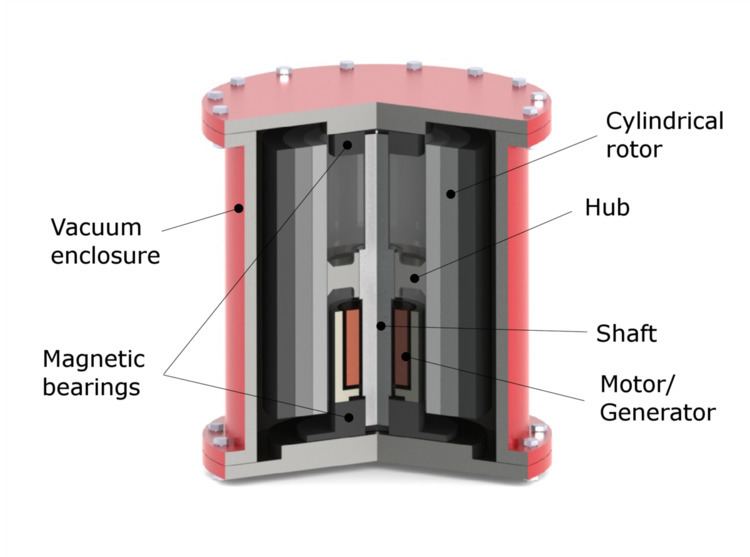
An even more exotic way is to use electrical energy overnight to spin around a large and heavy flywheel, then leaving it spinning on frictionless spindles in a vacuum till the energy is needed. It can then be used to turn a turbine to create electricity when required.
Figure 7 .Cutaway image of a flywheel for storing rotational energy.
Distribution of electrical energy
The shift from coal and oil to renewable sources of energy is bringing about significant change not only in the sources of our energy but also in the way it gets to us, the consumers. Throughout the twentieth century this problem was solved by linking the power stations dotted around the country to consumers via long cables suspended from pylons. To ensure that the supply was always there, whatever the level of demand and downtime of individual power stations, these links were eventually connected together into one giant network, the National Grid.
Julie remembered that “after the World Cup, everyone makes a cup of tea and electricity consumption surges. How does the Grid cope with changes in demand?”. It’s true the whole system has to be monitored minutely, second by second to ensure supply matches demand at each instant. Controllers are aware of real-world events in advance, and plan which power sources to bring on or switch off accordingly. Unexpected surges in demand cause generators to slow down very slightly from their normal rotational speed of 50 cycles per second. This may result in a tiny slackening of the power in your sockets for a few moments – something you wouldn’t notice.
Jean thought “it all sounds insecure with no stock of electricity”. Julie added to the sense of urgency having read that “the Grid can’t cope now.” It’s true, with more trains and motor vehicles switching to electrical energy each year and household heating and cooling systems moving away from fossil fuels, ever greater supplies are going to be needed. And the sources are no longer where they used to be – power stations by major rivers across the country. Instead, turbines out in the ocean and up in the hills or solar panels spread across fields and rooves are the new sources. The National Grid network not only has to be expanded, it also has to be re-routed to capture new supplies from the coasts, hills and fields. More controversially, new power lines are needed to connect us, the consumers, to the new sources of supply; and this means pylons across the countryside.
Julie wondered whether energy has to be transferred over such huge distances “can’t electricity supply be more local? Jean wondered “whether we couldn’t just connect up local sources”.
Local generation
There is certainly political will in the UK in 2026 to move towards generating electrical more energy locally. The CEO of Great British Energy – the new publicly-owned clean power company says “GBE aims to enable more users of energy to be active contributors to the energy system, helping manage the energy system through flexible use of electricity. Examples mentioned include rooftop solar in schools and hospitals, hydro-electric plants where there is water and elevation, and turbines where there is wind. An example in a block of flats in Cardiff is cited, involving the installation of rooftop solar panel systems and a set of batteries connecting 24 flats to affordable energy without the need to switch supplier.
“But how does it work” asked Patrick. “Can the electricity from your roof panels really flow back through your sockets?” It does seem odd, after a lifetime of taking electrical energy out of a socket, can we really feed it back the same way now? It’s true that is what is now happening. Previously the output from solar panels on the roof has been routed through a special box, called an ‘inverter’ installed by an electrician, feeding back into the mains supply. From here the energy from the panels feeds your own domestic needs, or, if it is in excess of what you need, feeds directly into the National Grid for use elsewhere.
The inverter is central to this, because your solar panel produces low voltage Direct Current (DC) and this has to be converted to Alternating Current AC and then stepped up to 230 volts to match the mains supply. The inverter adjusts the supply from your panel so that it exactly matches the grid.
AC and DC are explained in this blog – AC and DC. This blog explains Volts, Amps and Watts.
Today ‘microinverters’ are built into solar panel units rather than being a separate box fixed to your supply board by an electrician. This enables you to simply plug in the panel to a socket in the wall. The flow of electricity is monitored by a special meter which charges you for energy you draw from the grid but, when the flow is in the opposite direction from the solar panels to the grid, credits you for the energy you are supplying for others to use.
Bringing energy to you
Having grappled with the idea of energy coming to your home from multiple sources through the National Grid Julie asked: “what happens if you change provider”. This raised the whole question of who does what in getting the energy from the turbine to your kitchen and who gets the proceeds when you pay your bill.
The journey from producer to consumer involves the stages illustrated in figure 8 – generation, transmission, distribution and end use.
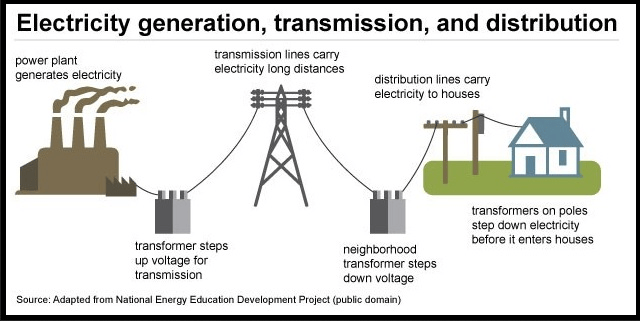
Figure 8. Diagram showing generation, transmission and distribution of electrical energy
To the surprise of everyone in the discussion group, all the organisations involved in this journey are private companies. Companies such as EDF and RWE, known as the ‘generators’, own and run the plant that generates electrical energy from traditional gas fired or nuclear power stations, wind or solar farms or hydro schemes. The more familiar names, such as Octopus, E-ON or SSE belong to the companies that distribute this energy to consumers, known as ‘suppliers’. National Grid plc, which provides the infrastructure for transmission and distribution is also a private company.
The ‘generators’ that produce the energy sell it to the ‘suppliers’ who sell it to us, the consumers. Prices are determined in a ‘wholesale market’ in which the price changes according to the cost of generating the energy needed to meet demand at that moment. The price changes throughout the day, based on fluctuating factors such as the cost of fuel, the amount of electricity being used and the strength of the wind and sun at any given moment. The price is determined every half hour.
The ‘retail market’ is the one you and I are more familiar with, in which ‘suppliers’ sell electrical energy to consumers like us in our homes and to businesses. These are the companies that send us the bill.
To maintain and develop the infrastructure owned by National Grid, the generators and suppliers all pay a fee to a new company called National Energy System Operator (NESO), established in 2023 as a government-owned entity. This is responsible for balancing supply and demand. The high voltage electrical energy from the power stations and wind and solar farms passes along cables to local areas where ‘local networks’ then convert the voltage to suit domestic uses (230 volts for homes). These local networks are owned by fourteen Distribution Network Operators covering regions across the country.
The cost of operating, maintaining and investing in the electricity transmission network is set by Ofgem every five years for building and maintaining the pylons, overhead and underground lines, cables and substations that transport electricity around the country. It’s also used to invest in new infrastructure to connect more clean energy, like wind and solar, to the network.
What you are paying for
The payments you make to your supplier every month have to cover the costs of all parts of the system. The biggest part of your bill is the cost of generating electricity. It’s calculated as a price per kilowatt hour, or unit, of energy you use. This unit price is set by your supplier and can vary according to the cost of generating electricity, which is directly linked to the cost of gas. Approximately 20% of your bill goes to pay for the infrastructure for transmitting and distributing the energy – the substations, pylons and cables across the countryside and under the roads. About £100 on average goes to the local distributor to build, maintain and invest in the local distribution network. These are fixed charges set by the energy regulator Ofgem.
The pie chart gives an impression of how much of the bill you pay goes to generate the energy (‘wholesale’) – a little over a quarter – and how much for the network that transmits and distributes it – a little less than a quarter. ‘Operating costs’ are the overheads of running the companies and environmental costs are the investments needed to reach net zero carbon dioxide emissions.
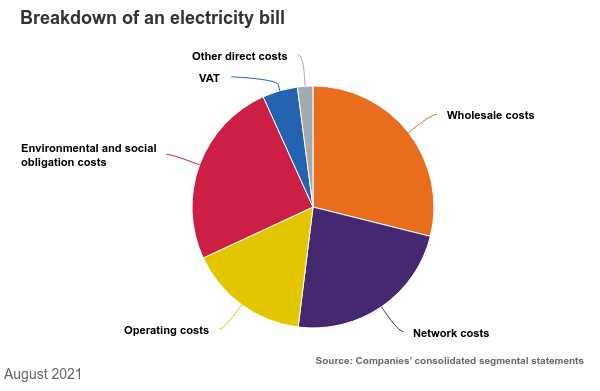
Figure 9. How your payments for electrical energy are divided up .
Conclusion
For most of us, electricity is something we use almost without thinking as we switch on a light or jump on a train. We become aware of the extensive infrastructure that brings us this energy only rarely: giant pylons striding across fields, humming substations in a hidden corner of town. The cost of it all is brought home to us regularly, however, when we open our bills. In this blog we have looked at the scientific principles underlying this profoundly important aspect of our daily lives – the generation of electrical energy, the flow of current, and the means of getting it to where it’s needed. The rapid shift away from coal, gas and oil will mean dramatic changes in the infrastructure required to carry the electrical energy that will replace them.

