
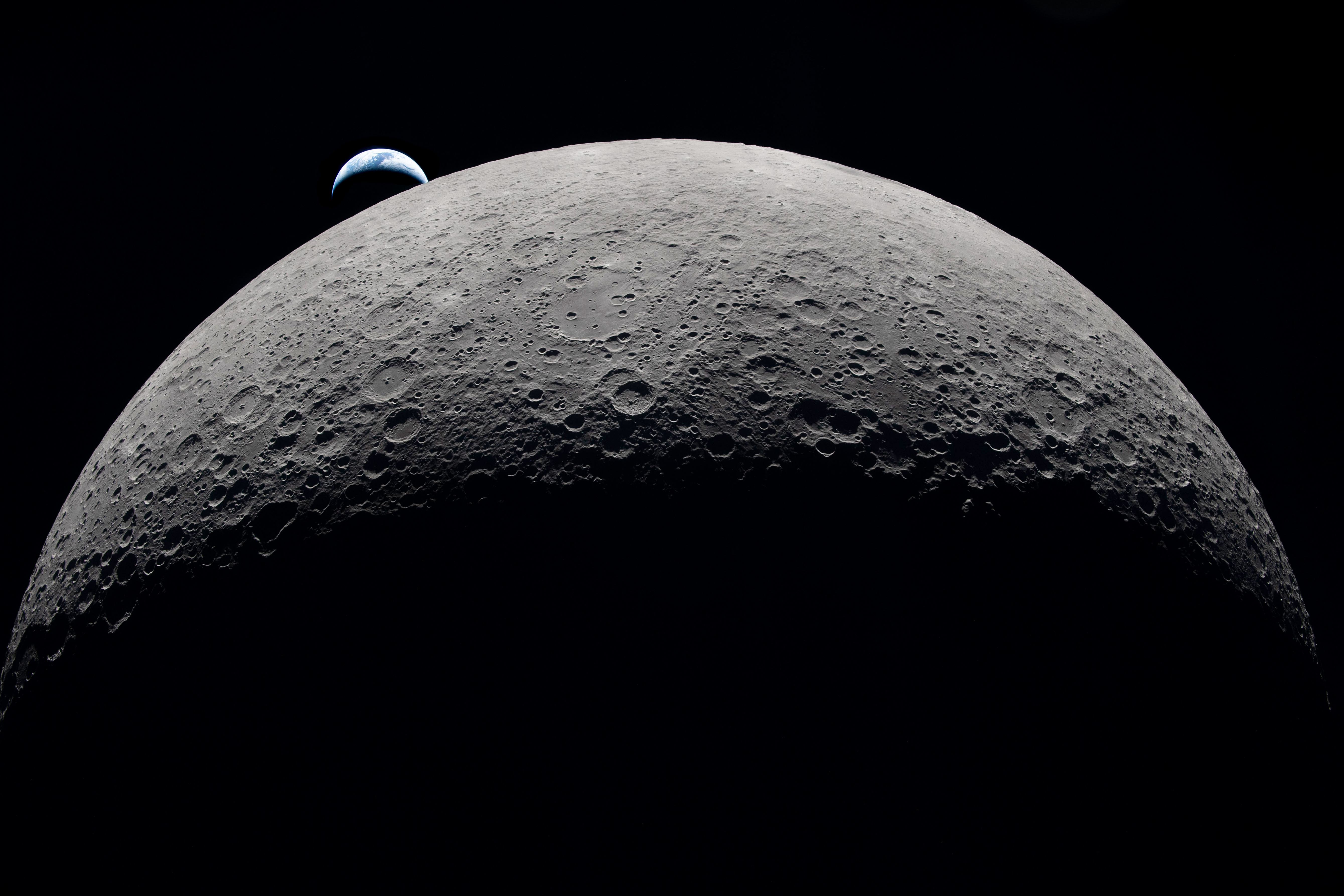
The science event of the year was surely the journey of a tiny capsule the size of a modest motor home careering around the back of the Moon and returning home safely.
Figure 1 Far side of the Moon with Earth in the background
Media accounts talked of unprecedented images from the far side, the triumph of technology and the unusual diversity of the crew. Few however tackled the burning questions readers of these blogs will have been asking. If their fuel tanks were jettisoned so early, how did the spacecraft make it all the way there and back? If they left the gravitational pull of Earth, when did the Moon’s kick in? What is a slingshot, anyway? Most intriguingly, what happened to the toilet?
These questions touch on concepts in physics that have perplexed or bored endless generations of schoolkids, yet for many adults the questions remain compelling, and the answers often go against all expectation. With inspiring images of the Artemis voyage still fresh in mind, it’s a good time to look at afresh at these.
Forces and motion.
It’s hard for any of us to really grasp a fundamental truth that eluded even the wisest till the seventeenth century: things that are moving just keep on doing so without any assistance when nothing is acting on them. And of course, out there, all things are moving relative to one another: there’s no stationary in space. Just ploughing ahead at a steady speed is the norm for all things in the universe, unless some kind of force stops them or alters their course. Here on Earth, we don’t experience this; friction is always there at our feet and in our engines to hold us back. In the air above and water below, resistance slows our pace: we are never free of some force or other acting on us and everything around us. No wonder the idea of a vehicle out in space, travelling on and on with barely any fuel is hard to get our head around. Out there, there’s nothing to slow things down; speed remains steady indefinitely, at least until another force is encountered.
What Galileo and then Isaac Newton helped us realise is that when we drive at a steady 70 mph on a motorway the overall force must be zero. The motor is providing exactly the forward force needed to balance the drag of friction and air resistance. The space vehicle Orion, hurtling through the emptiness of space with its crew of four, was travelling unpropelled for hundreds of thousands of kilometres, once away from any significant pull from Earth’s gravity.
Getting away from Earth in the first place, however, is another story. Here there is a net force pulling the capsule and its rocket system back towards the centre of the Earth: gravity, what we call its weight. To overcome this and to lift off, the capsule is attached to a rocket with powerful thrusters. The bright fiery plumes of gas streaming from the bottom of the rocket provide an upward force that not only balances the weight of the rocket and capsule but adds a bit more to speed them upwards. After eight minutes, when Artemis II was travelling at 18,000 mph (29,000 kph) the main rocket was jettisoned, reducing the weight massively.
Three hours later the rest of the propelling machinery was jettisoned leaving the Orion capsule alone on its voyage through space. The space craft now consisted simply of a conical crew module with the service module attached behind, complete with solar panels to provide electricity.
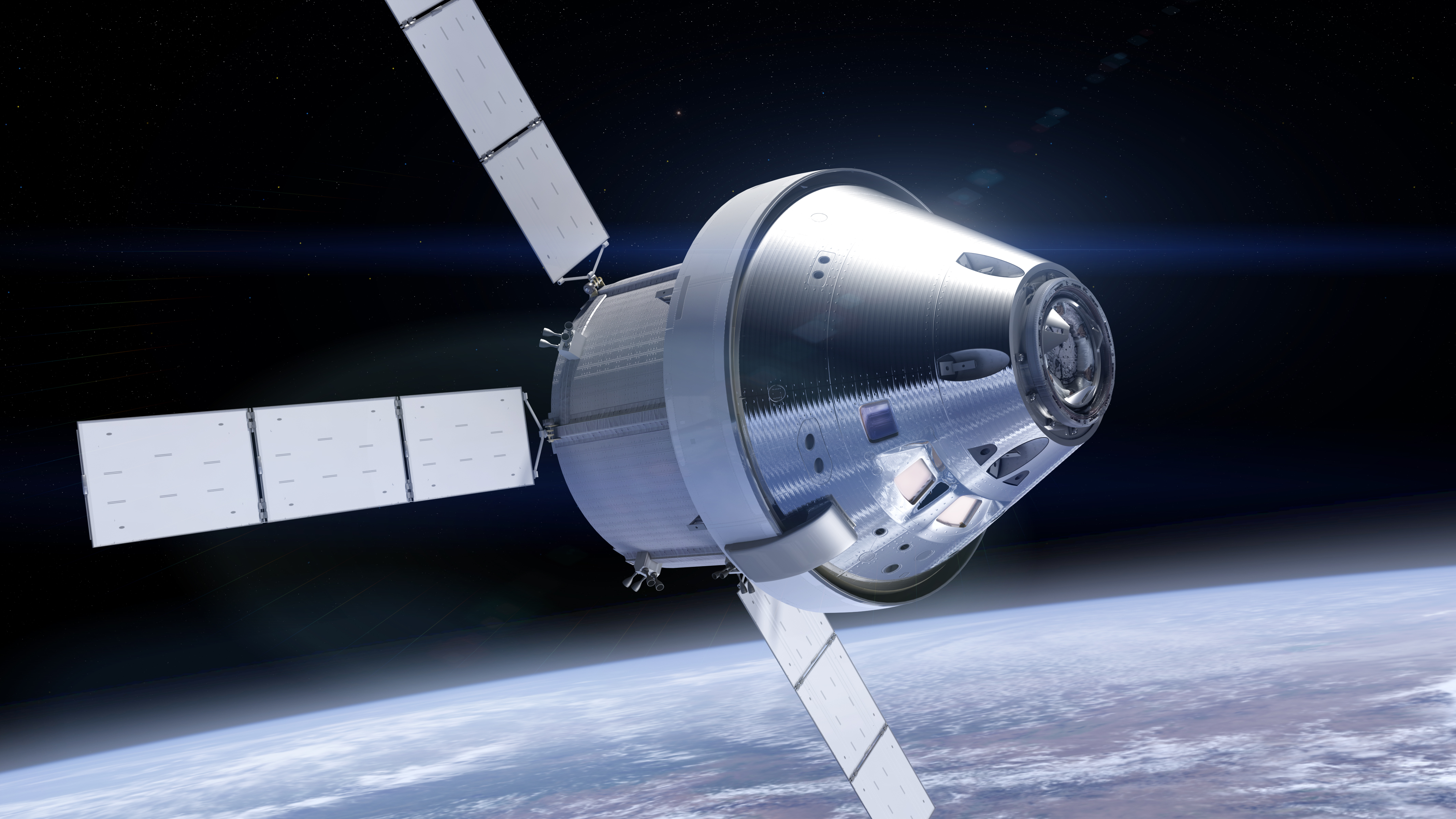
Figure 2 Orion crew module with service module attached
Gravity
Familiar thought the concept of gravity has become since Newton’s time, it’s still hard to get a feel for its essential nature. In everyday life we take it for granted: it plants us firmly on the ground, it brings a tennis ball down after we hit it upwards, it drives rivers towards the oceans. Life would be very different without it, yet it offers nothing for us to see or touch. Gravity is an invisible presence surrounding all objects, spreading its influence all around. What Newton realised is that gravity is simply an inherent property of matter – all matter, all things. What is more, the strength of gravity depends on the amount of matter, on the mass of a thing. The more massive something is, the stronger will be the gravity associated with it. Nevertheless, gravity is still a very weak force compared to that of magnets and muscles; unmeasurably tiny for everyday objects like me, you or the kitchen table. The effects of it are only noticeable when very large masses, like the Sun, Earth or Moon are involved. It is amazing that Newton was able to link the idea that a small thing like an apple falling to Earth, was due to the massive size of the Earth; and even more amazingly, that the Moon was held in orbit around the Earth for the very same reason.
The other notable characteristic of gravity, apart from its relationship to mass, is the way it weakens with distance. Like the brightness of a light or loudness of a sound, its strength diminishes the farther you are from the source. It doesn’t just fade gradually, either: it diminishes rapidly, ‘as the square’: twice as far away and its four times weaker.
So, for getting to the Moon, a lot of force is needed at first because gravity is strong on the Earth’s surface. That’s why powerful thrusters are needed to lift the rocket off, loaded as it is with tonnes of fuel. But with increasing distance from Earth, the force of gravity weakens rapidly. By the time you are halfway to the Moon the Earth’s gravity has weakened around a thousand times. Out there you would ‘weigh’ a thousand times less – maybe 50 -100gms, less than a packet of butter! That’s why we see the astronauts floating around so freely there.
Leaving the Earth means closing in on the Moon; as the Earth’s gravity fades, the Moon’s grows. At some point the very slight backward pull of the Earth and the very slight forward pull of the Moon will exactly balance out – after about 90% of the journey from Earth to Moon. This occurs closer to the Moon because its gravity is much weaker than Earth’s. Thereafter the pull of the Moon grows ever stronger eventually dominating the force on the vehicle, drawing it into an orbit around the far side of the Moon. There’s no sudden crossing of a territorial boundary, of course: as one influence smoothly fades, so the other grows.
Orbits
One look at Artemis II’s trajectory raises a host of further questions for the discerning observer. What is it that determines the shape of an orbit? How did they manage to get it to loop around the Moon and back to Earth so neatly? Was no more fuel needed to keep it on track?
The journey is traced out in figure 3 with key moments indicated by numbers. Position 1 marks the launch; the rocket boosters are jettisoned soon after at position 2. By position 5 the vehicle is in high orbit and at 7 its final propellent-containing module has been jettisoned. From here on the Orion vehicle with the crew aboard was on its own. It orbited the Earth once for a couple of hours so that systems could be checked, then underwent an important ‘burn’ at position 9 using thrusters in the service module attached to the crew module. Thereafter the trajectory was essentially determined by the combined forces of gravity of the Earth and Moon, with a little occasional help from small thrusters in the service module. The long journey ahead took four days, with the craft passively following the laws of gravity.
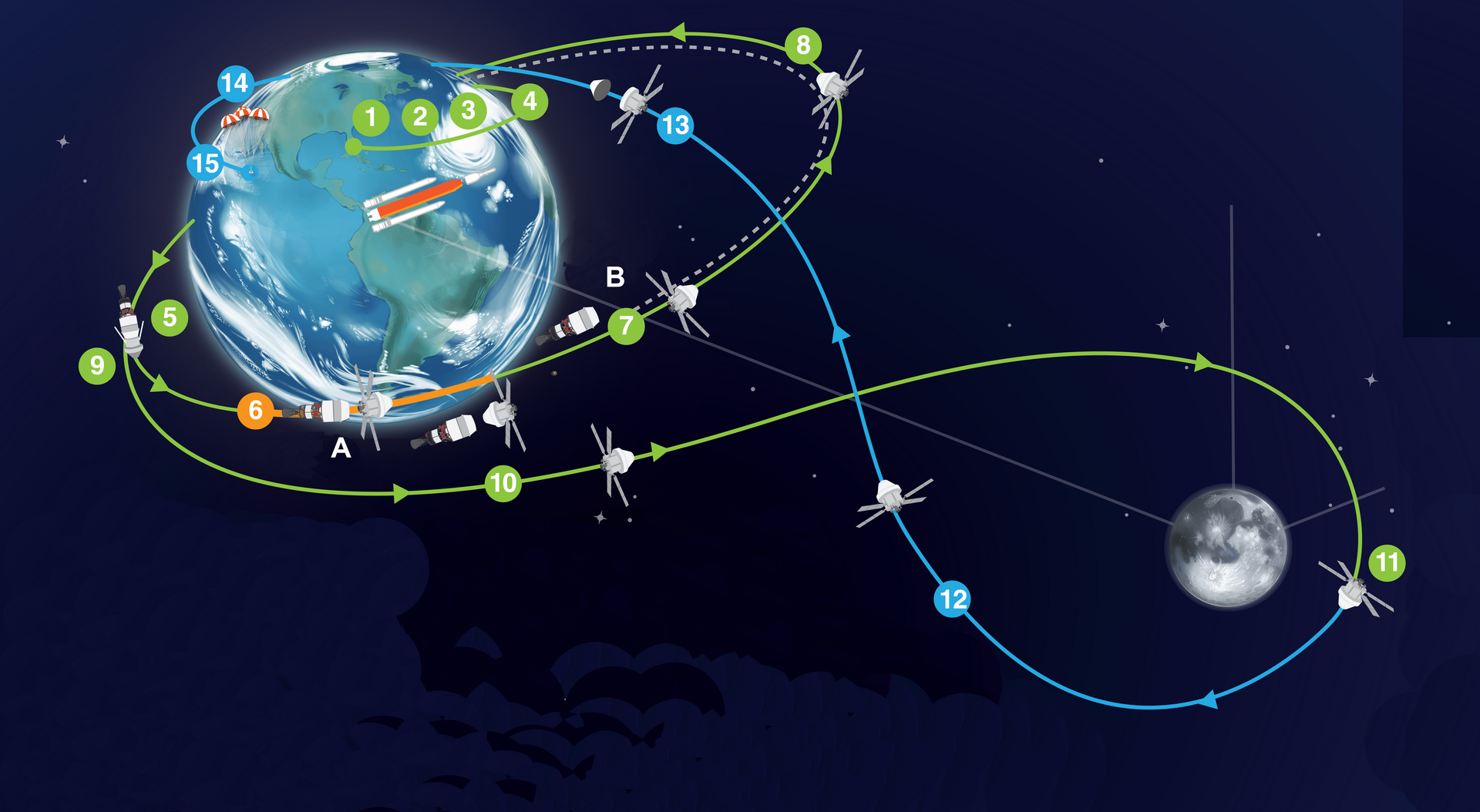
Figure 3 trajectory of the Artemis mission
The kind of orbit we are most familiar with is the type that keeps our satellites revolving around Earth.
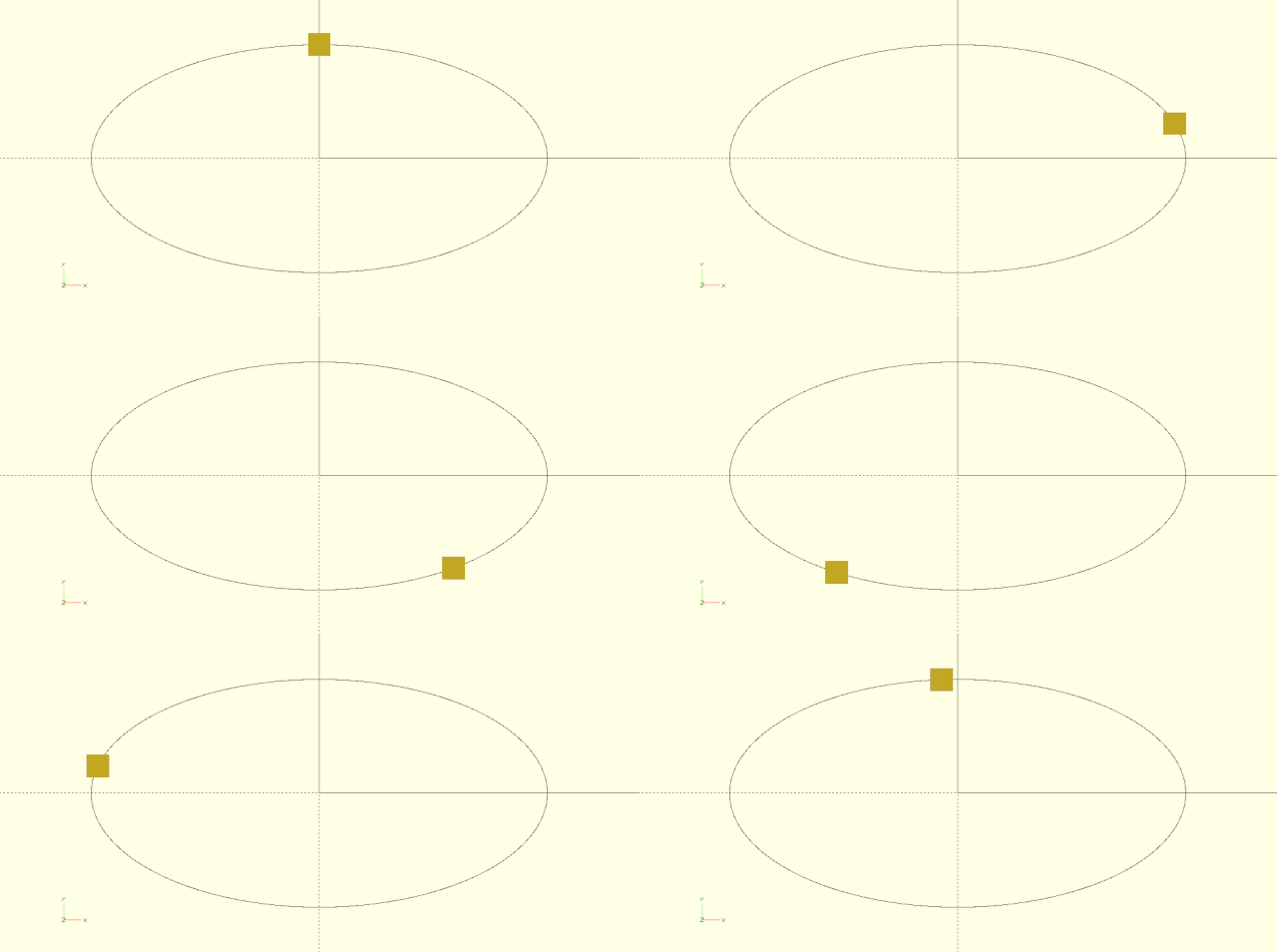
It’s the same as the type that keeps the Moon rotating around Earth and the Earth and other planets revolving around the Sun. The shape of all these closed loops is an ellipse (oval). If the two dimensions of an ellipse are almost the same length, as for the Earth and the Moon, the ellipse is almost a circle.
Figure 4 elliptical orbit
The height of an orbit above the surface depends on the speed of the of the satellite or space vehicle. The slower it’s moving the higher the orbit. Typically, a satellite in a low orbit around the Earth travels around 7.8 kms per second, and one in a high orbit travels around 3.1 kms per second.
What fascinates followers of the Artemis mission is that the space vehicle is neither captured in an orbit around the Moon, nor does it just fly past into deep space. Instead, the effect of the Moon’s gravitational force is to bend the trajectory just enough to swing the vehicle most of the way around the Moon, but not enough to trap it into a closed ellipse.
When Newton’s gravity law is put together with the mathematical equations of motion, various kinds of orbit are found to be possible, including an ellipse, parabola or hyperbola. Elliptical and circular orbits are closed, hyperbolic and parabolic are open. These orbit types apply equally to human-made space vehicles orbiting the Moon and to planets revolving around the Sun.
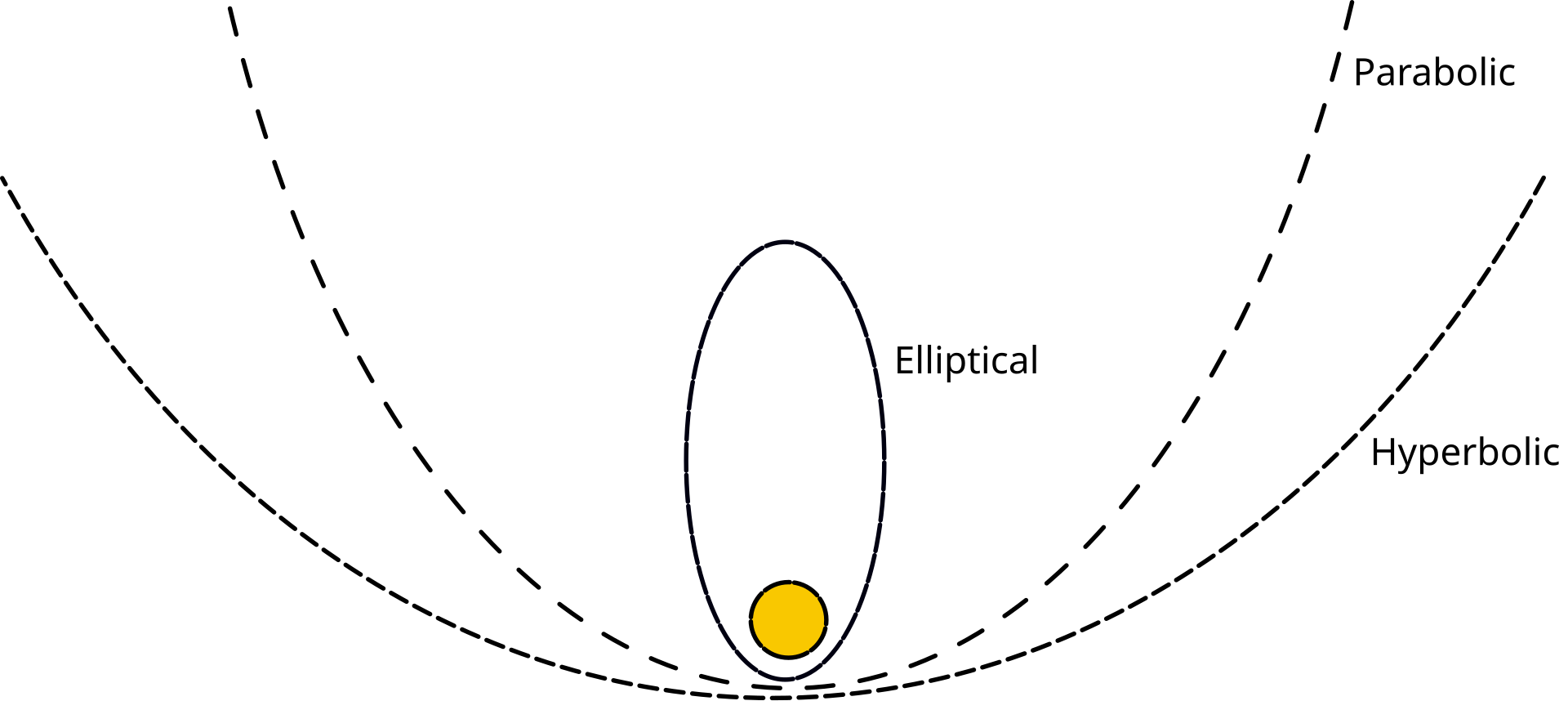
Figure 5 Different kinds of orbit
Which kind of orbit a space vehicle will follow depends on its speed relative to a planet or Moon and on its trajectory as it approaches at a glancing angle. For any space mission these conditions will have all been calculated in advance. In the case of the Artemis II mission, these will have been determined to ensure that the Orion capsule swings around a path just far enough to get bent back on the chosen path to Earth. The Artemis path around the Moon is known as a ‘slingshot’. It’s a process that enables the capsule to pick up extra speed by interacting with the forward motion of the Moon itself – rather like a shotputter twisting around to add the speed of their whole body to that of their throwing arm. This takes the capsule farther round the Moon than a purely hyperbolic path, enough to send it back towards the Earth.
Thereafter, it continues, unbound, moving smoothly ever further away from the Moon. The influence of the local gravity fades while that of the approaching Earth grows until, just as on the way out, a point is reached where the two are matched. From this point onwards Earth’s gravity dominates the shape of the return path.
The entire trajectory, from lift off to touch down, is programmed in advance with instructions to switch thrusters on and off at various stages of the journey. Out in space, there are few hazards to be avoided, but nonetheless minor adjustments are likely to be needed on the way. For this purpose, the service module attached to the module in which the astronauts are travelling is equipped with small thrusters and a reservoir of propellant to fuel them. This part, the service module, was the bit of the whole Artemis II vehicle that was built in Europe.
Orion space vehicle
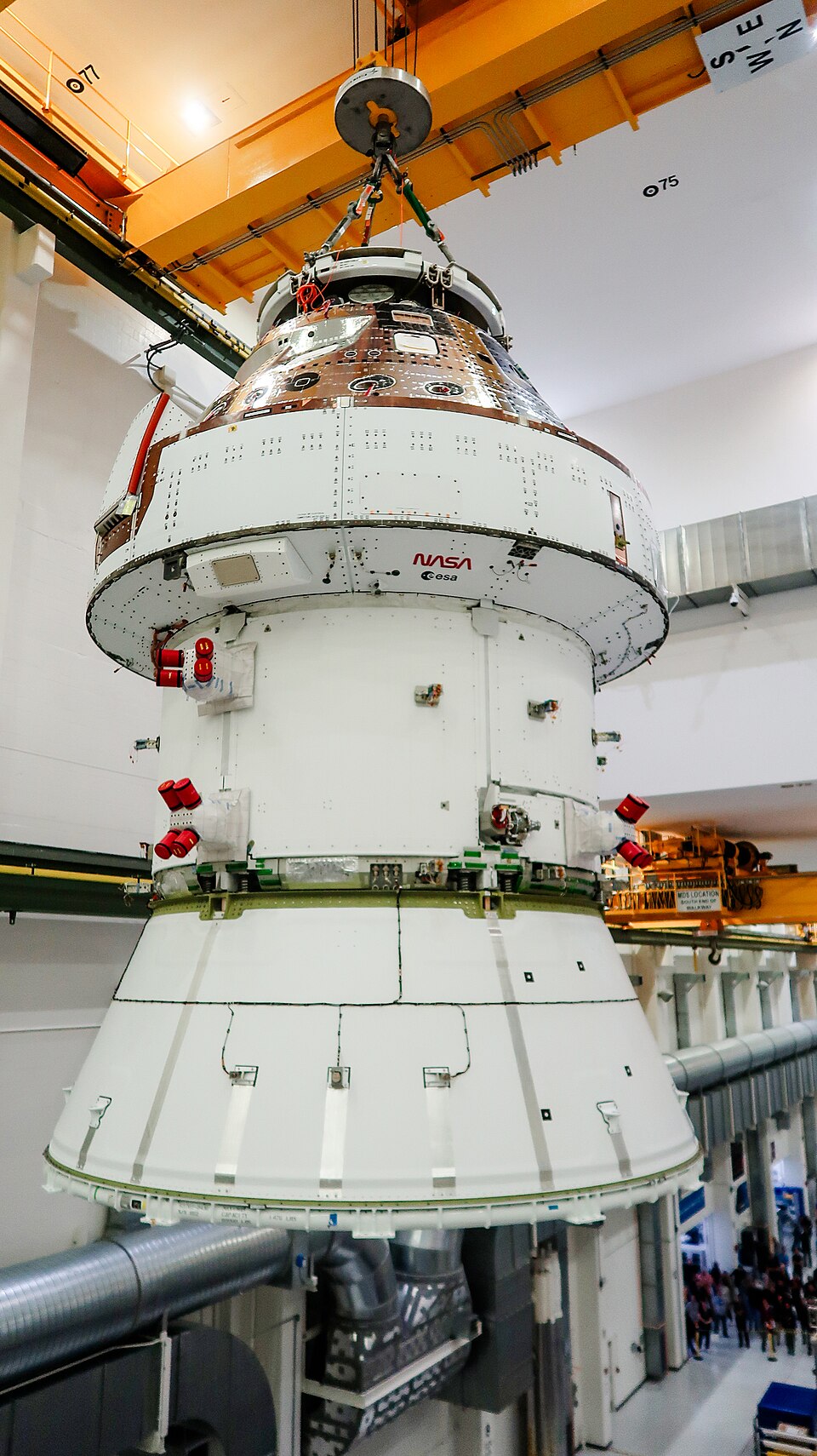
Figure 6 shows the Orion vehicle in detail, during pre-testing. The conical shaped crew module in which the astronauts live is at the top. The distinctive brown colour of the heat shield is pierced by small windows through which the crew got personal glimpses outside and took photos. The larger, three-part service module is attached underneath. The job of this module is to adjust the trajectory as needed, supply the crew with oxygen and water and maintain a comfortable temperature for them. Solar panels projecting out from it (not shown here) provide electricity for this purpose.
Figure 6 Orion space vehicle with crew module above and service module below
The service module stays attached to the crew module throughout the journey up until they reach the outer realm of the Earth’s atmosphere in the final stages of the return journey. The service part is then jettisoned and burns up as it rushes through the atmosphere, heated by the resistance of molecules in the air as it ploughs through them at the phenomenal speed of 38,000 kph (24,000 mph)
The crew module continues on unharmed as it is protected by the heat shield on its outer surface. This reaches a temperature of over 2,700 degrees Celsius at its peak, while the astronauts remain cool beneath the 4 cm thick heat-resistant shield. To reach a slow enough speed at touch down the vehicle has to decelerate dramatically. The air through which it is passing provides the drag force needed to achieve this. The ‘braking’ effect is as severe as 8 to 10 g at its peak, i.e. crew members are pushed back with a force 8 to 10 times their own bodyweight – like 8 to 10 people heaped on top of you on Earth!
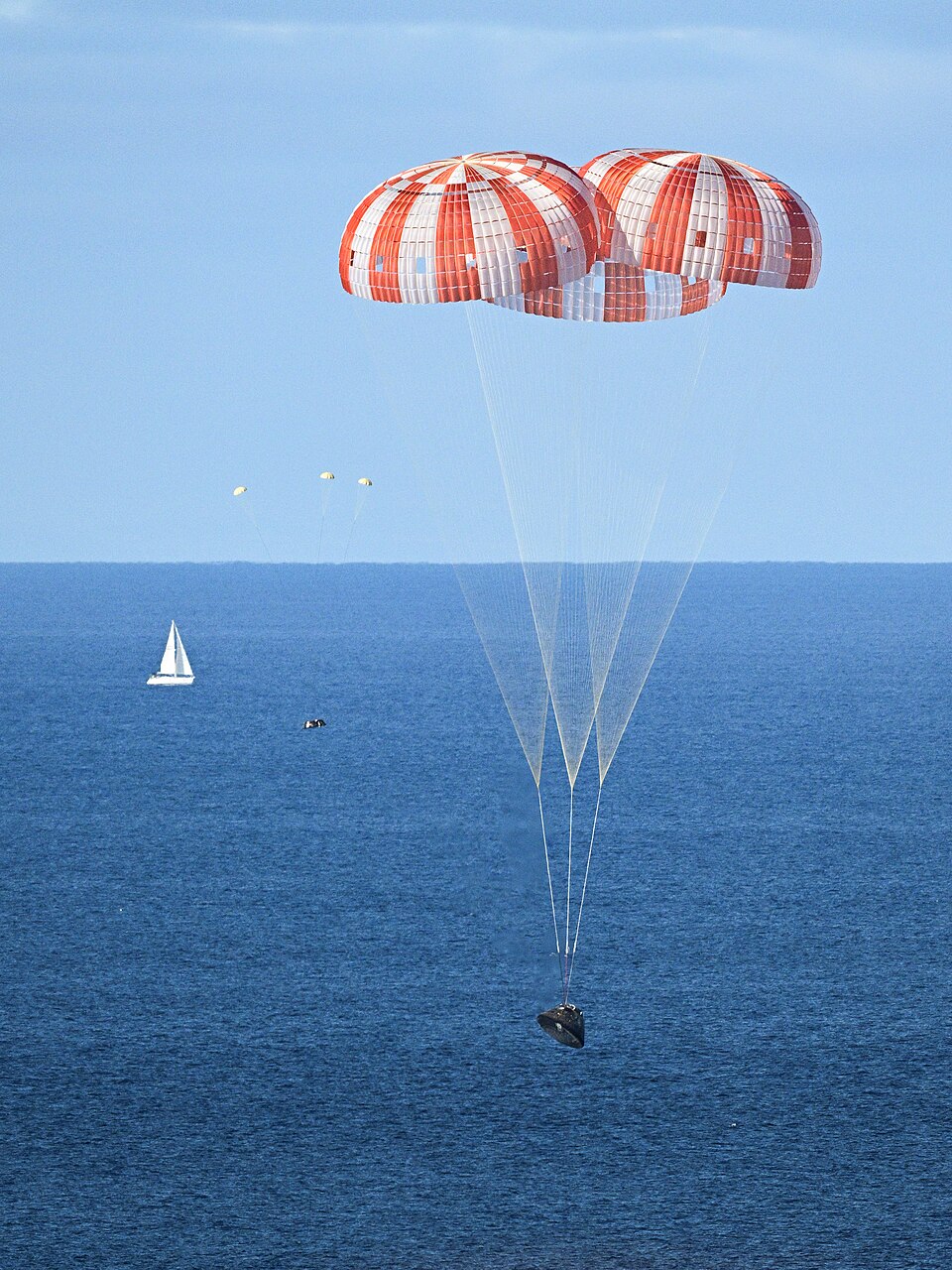
Finally, once the atmosphere had slowed the capsule down to roughly 523 kph (325 mph), the parachutes were released to achieve a splashdown speed of around 20 mph. Altogether a tough experience for the astronauts, first pressed by very strong g-forces then feeling the bump on hitting the surface of the sea.
Figure 7 Splashdown
Conclusion
The shape of the Artemis journey has shown us just how simple, yet profound are the laws of physics that Isaac Newton put together roughly 350 years ago. He worked out both the simple equation that describes the strength of the gravity force and the equations that predict how things will move in the presence of a force. Put together, these enable calculations to be made with sufficient precision to get human beings around the Moon and back again without harm – amazing! Einstein, it’s true, uncovered the shortcomings of this theory two hundred years later, and wrote the equations that correct it. But, for practical purposes, like getting to the Moon, the modifications are so marginal at the speeds involved that they would barely have made a millimetre of difference over the whole trajectory.
Oh, and what about the toilet? Apparently, the suction mechanism got blocked. One version of the story holds that it iced up in the cold of space; the cunning work-around was to use thrusters to tilt that side of Orion more towards the sun to melt it. High end plumbing, indeed.
© Andrew Morris April 2026

